Week of October 25-31, 2026
It's that time of year when we'll soon be greeted at our front doors by a variety of odd characters. No, I don't mean politicians stumping for your vote; I mean monsters, superheroes and rock singers all begging for a treat.
"Trick or treat!" they'll shout, and we'll gladly give them handfuls of candy to prevent some trickery on their part. I only wish that worked with politicians ... but I digress.
Of all the characters that appear at your door this year, how many astronomers do you think will be represented? Galileo? Sagan? Mammana? Not one, I'll bet. And that's a darned shame, considering that Halloween has its roots deep in the heavens.
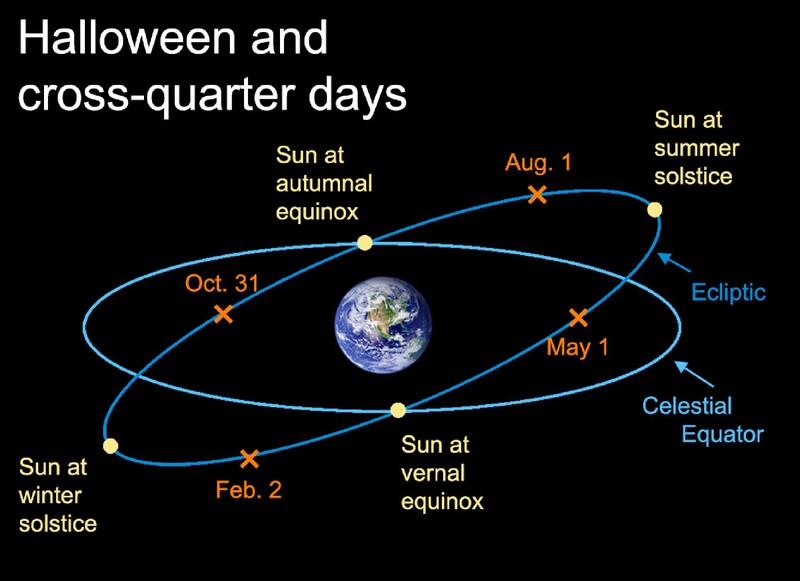
We owe this holiday to the seasons and our planet's annual orbit around the sun. Everyone knows that autumn began in the Earth's Northern Hemisphere a few weeks ago on Sept. 22 — the autumnal equinox — when the sun crossed the celestial equator on its way southward. We also know that winter will start on Dec. 21 — the winter solstice — when the sun reaches its southernmost point in the daytime sky and begins its northward journey once again.
We hardly ever think about the details; we just recognize these dates as the beginning of new seasons, and that's that; but it wasn't always this way.
Back in the days of the ancient Germanic and Celtic cultures, folks believed that the seasons started not on the equinoxes and solstices, as we do today, but rather on dates midway between them. "Cross-quarter days," they called them, and there were four throughout the year. Today we know Feb. 2 as Groundhog Day, May 1 as May Day, and Aug. 1 as Lammas Day. And Oct. 31 is — you guessed it — Halloween.
To the Celts, winter began with Halloween — or, as they called it, "Samhain" (summer's end) — which marked the transition between summer and winter, light and dark, life and death. This was also the Celtic New Year's Eve, when people celebrated with a great fire festival to encourage the sun not to vanish. On this frightful evening, people danced around massive bonfires to repel demons but left their doors open in hopes that kind spirits of loved ones might join them around their hearths.
It was in later pagan and Christian traditions that, at this time of year, people went out in masks and robes to frighten away evil spirits; some even traveled from farm to farm carrying hollow turnips with candles inside and demanding food to honor an old god, Muck Olla.
It's plain to see how these ancient traditions have influenced our modern holiday customs at this time of year. When the ghouls, ghosts and goblins show up at your door, try to remember how the whole thing has an astronomical origin.
And this Halloween, let's hope that at least one of those yelling "trick or treat" is dressed as an astronomer. In fact, why not attend your office Halloween party dressed as an astronomer? I must warn you, though ... if you should choose me as your subject, you may send your coworkers shrieking out the door.
Now that'll be a Halloween party to remember!
Visit Dennis Mammana at dennismammana.com. To read features by other Creators Syndicate writers and cartoonists, visit the Creators Syndicate website at www.creators.com.
Halloween has deep roots in astronomy.







View Comments